

The question comes up every few years, usually from someone under thirty who has just bought their first serious instrument and wants to talk shop. They look at my strings the way a young doctor might look at a colleague still using a stethoscope from 1970 — not unkindly, but with the quiet certainty of someone who has read the literature. "You know," they say, or some version of this, "steel strings would give you a lot more projection. Easier to play in tune, too." They are not wrong. That is the thing I always have to explain.
Gut strings have been out of fashion for professional bassists for the better part of fifty years. The reasons are sensible. They go out of tune with every change in humidity. They are expensive — genuinely, insultingly expensive, for something that will need replacing inside a year. The tension is lower than steel, which means the action has to be set differently, which means the instrument is less forgiving on tired hands. In cold weather, a gut string can lose a whole step between the dressing room and the stage. I have been in climates where the bass was fighting me for the entire set and nobody in the audience knew it because holding the pitch is not the audience's problem, it is mine.
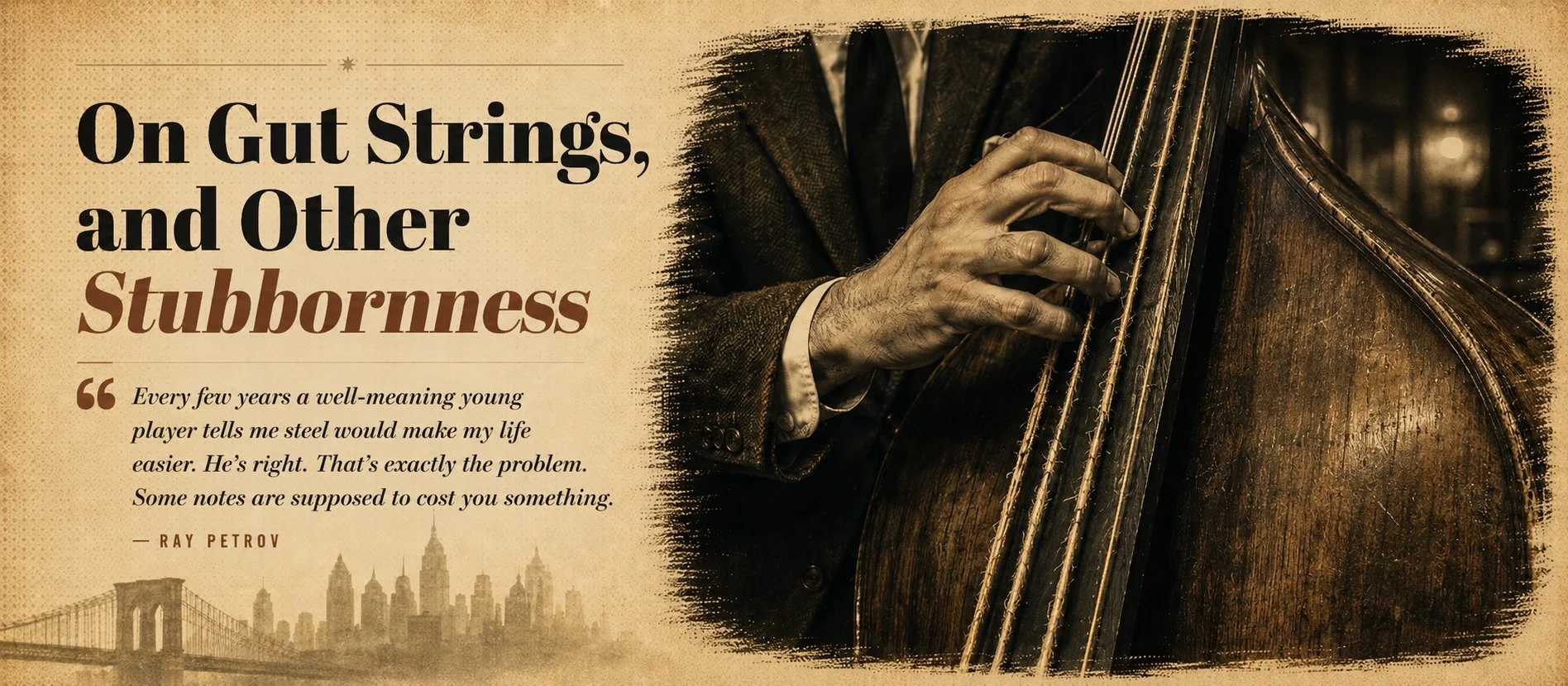
The gut doesn't give you the note. You have to pull it out of the string, and that negotiation — that small contest between the player and the instrument — is audible. It is in the tone. — Ray Petrov
So why do I use them? The same reason I still play the Czech flatback I bought in 1994 instead of the newer instruments that are objectively better in every measurable sense. The gut string sounds like a person playing a bass. The steel string sounds like a bass being played. It is a small difference in the phrasing and a very large difference in the result. On a recording, you can hear it in the attack and the decay — the gut note blooms differently, opens up in the middle of its life rather than at the front, and dies with a kind of personality that a wound steel string never quite achieves. In a room, you feel it in your chest before you analyze it with your ears.
What I have never found a good way to explain to the young players who ask — because this sounds like romanticism and I am not by nature a romantic — is that the difficulty is part of it. The gut doesn't give you the note. You have to pull it out of the string, and that negotiation, that small contest between the player and the instrument, is audible. It is in the tone. The player who has wrestled the pitch into place sounds different from the player for whom the pitch arrived easily, and audiences who don't know a gut string from a garden hose can hear that difference. They may not know what they are hearing, but they know something is at stake.
Paul Chambers used gut. Ron Carter played on gut for the better part of his early career before moving to steel. Ray Brown, who could have played anything and had the commercial leverage to demand whatever he wanted, played gut strings in his later years because he said it brought him back to something. I think about that word — back. Not backwards. Back to a sound that preceded the convenience, back to a physical relationship with the instrument that required the player to be fully present. You cannot coast on gut strings. The moment you stop paying attention, the instrument tells you.
I am aware this could all be dressed-up nostalgia. A man who bought his first bass from a pawn shop for eighty dollars is probably not the most objective witness when it comes to assessing the merits of difficulty. But I have made the switch to steel twice in my career — once for a stretch in the 1990s when I was doing a lot of studio work and the engineers asked for it, once for about eight months in 2008 when I was having hand problems and the lower tension was genuinely therapeutic. Both times, I went back. The playing was easier. The music was flatter. A kind of pressure went out of the room that I hadn't noticed was there until it was gone.
The well-meaning young players are right that easier is better for most things. Easier transportation, easier intonation, easier tuning, easier everything. I am not arguing against ease as a general principle. I am only saying that for some work — for the kind of work where what you are making has to carry weight the way a walking bass line has to carry an entire ensemble — the ease of production and the quality of the thing produced are not always moving in the same direction. Some notes are supposed to cost you something. The audience can tell when they didn't.