

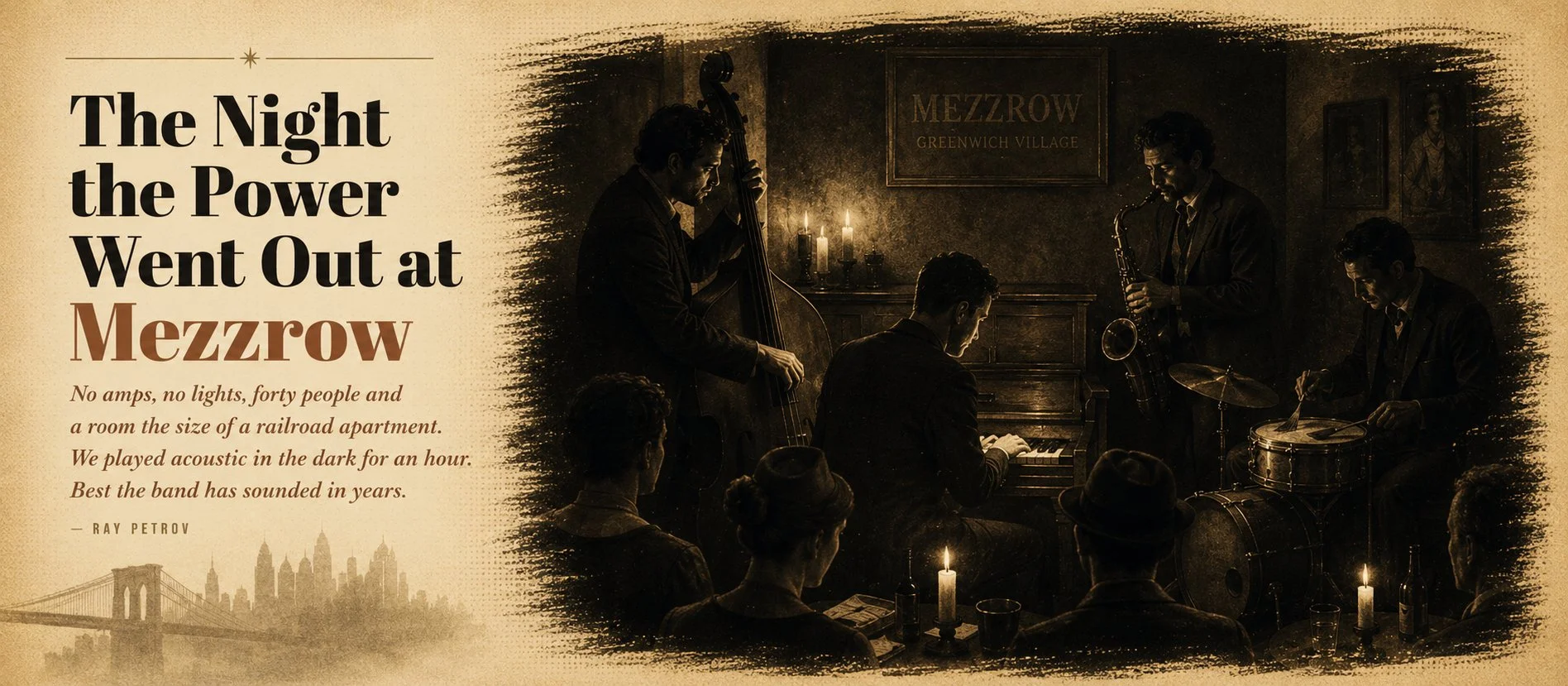
It was a Thursday, late in April, and we were three songs into the second set when every light in the room went out at once. Not a flicker, not a warning — just the world going dark between one beat and the next. I kept the time. That is the only thing I know how to do in an emergency, and forty years of muscle memory is hard to argue with. Marcus, our pianist, lifted his hands off the keys, then put them back. Jimmy held the note he was on for another bar before the saxophone went quiet. The drummer hit the cymbal once, checking if anyone was still there. We all were.
Mezzrow runs on a sound system just big enough to give the piano a little body in a room that seats forty on a good night. Without power, we were working with what the instruments themselves could produce: a Czech flatback from 1948, an upright Steinway that the room itself seems to have been built around, a saxophone, a drum kit with brushes. The audience — forty people, maybe a few more, sitting close enough that you could smell the bourbon — stayed exactly where they were. Nobody left. Nobody reached for their phone. One person near the back lit a small candle they had apparently been carrying, which I found both strange and correct.
Every amp I have ever stood next to has put distance between me and the room. Even a good system — even a subtle one. The audience hears a representation of the music. Acoustic, they hear the music itself. — Ray Petrov
We played for fifty-five minutes that way. "All the Things You Are," a slow blues I don't have a name for, a version of "Autumn Leaves" that became something else around the middle eight and never quite came back. Jimmy played quieter than I have heard him play in a decade. Not timid — the opposite of timid. He was listening to the room, measuring how much the room could take, and giving it precisely that much. Marcus found voicings I had not heard him use before, spare and widely spaced, each note given room to breathe and decay before the next one arrived. Terrence on drums used brushes for the entire hour, which is not like him. He is a man who plays the drums. Thursday night he played time.
The power came back on somewhere in the third song after the break. The house lights came up slowly, and people blinked at each other as if waking up in a room they did not recognize. Someone started to applaud, then thought better of it and let the song finish. When it did end, the room came down around us. Standing ovation, which almost never happens at Mezzrow. The bartender, who has seen everything in that room, was standing behind the bar looking at something in the middle distance with an expression I could not quite read.
My theory — and I want to be honest that it is only a theory — is this: amplification teaches musicians to play to the system rather than the room. Not dishonestly, not lazily. It is just that when you can hear yourself clearly through a monitor and the sound person can adjust the balance, you stop calibrating to the physical space and start calibrating to the signal. Over years, that becomes a habit so deep you don't know you have it.
Take the amplification away and something older takes over. You start listening with your whole body. You feel the bass in your sternum. You feel where the sound goes when it leaves the instrument, and you adjust — the bow pressure, the angle of attack, how long you let a note ring before pulling it. The room becomes a collaborator instead of an obstacle. And the audience, without speakers between them and the source, stops being spectators and becomes something closer to participants. Forty people in a dark room breathing together around four musicians. I have played in Carnegie Hall and I have played in a broom closet, and what happened Thursday night felt more like music than most of either.
I am not recommending anyone cut the power on purpose. That would be a stunt, and stunts are what you do when the music isn't enough. What I am saying is that if it happens to you — if the lights go out and the amps go quiet and the room goes dark — don't stop. Keep the time. Put your hands back on the keys. Blow the note you were going to blow. The best review you will ever receive is forty people who could have left and didn't.